
Choosing Marble Finishes for British Interiors
Natural stone projects are often described through atmosphere first: a pale surface, a dramatic vein, a quieter floor or a striking arrival point. That language matters, yet it becomes useful only when it is translated into decisions that a producer, fabricator and installer can share. For interior designers, homeowners and fabricators working in the United Kingdom, the central question is how the character of polished, honed, brushed and textured surfaces should be handled from the first enquiry through to the finished project. Marble Producer UK approaches that question as a material and coordination exercise, not as a catalogue sale. The goal is to help a project specify Turkish stone with enough clarity that beauty, programme and practical delivery remain aligned.
Begin with the application, not the image
Every decision changes once the intended use is named. a kitchen, bathroom, feature wall, floor or hospitality surface has its own demands for thickness, handling, finish, joints and long-term care. A photograph can suggest a visual direction, but it cannot answer whether the material will be exposed to water, frequent cleaning, impact, direct daylight or high footfall. That is why an early brief should record the location of the stone, the visible faces, the approximate dimensions and the adjoining materials. It gives the project a shared language before anyone commits to an unrealistic slab, format or edge profile.
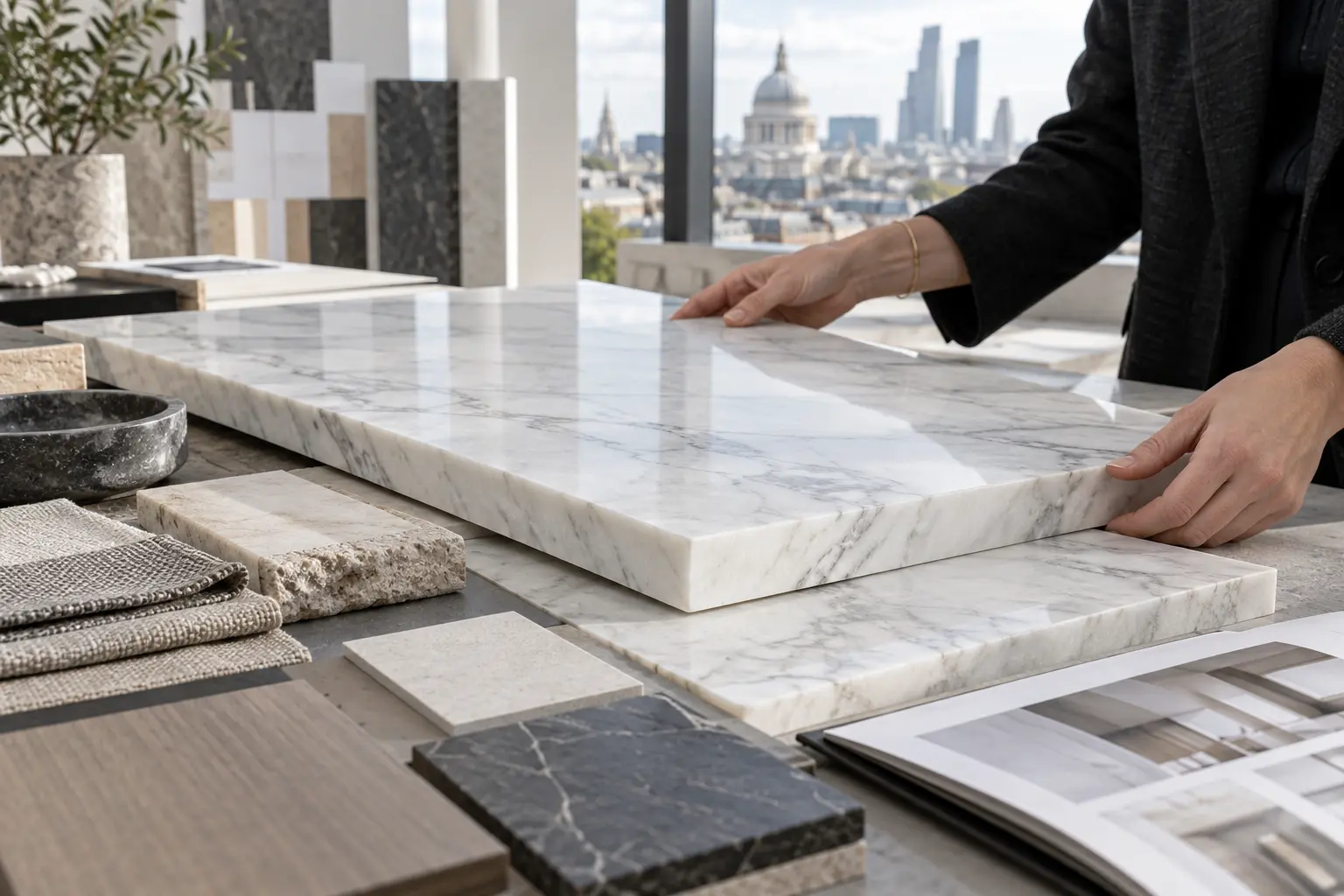
The most productive early review uses real finish samples viewed beside timber, metal, paint and local light. These are not administrative extras. They reveal whether the preferred stone can carry the design in the dimensions required, whether its natural movement works across connected pieces and whether production can follow the intended sequence. A useful review also identifies what must stay fixed and what can remain flexible. It may be essential that a vein runs through one feature panel, while a secondary return can accept a calmer area of the same block. Knowing that distinction protects both the visual result and the usable yield.
Read natural variation with confidence
Stone gains its value from variation, but variation needs direction. Background tone, open veins, mineral marks, fills and changes in movement are normal characteristics rather than faults by default. The project should agree the acceptable range before cutting begins and avoid language such as “match the sample exactly” when a small sample cannot represent a full slab. In the United Kingdom, where a project may pass from a design studio to a fabricator and then into a tightly scheduled site, visual approval should be recorded with enough detail that the same expectation survives each handover.
This is also the stage to compare surfaces under the actual conditions of use. Polished stone can bring light and depth to a protected vertical face; a honed or textured finish may be the more responsible choice for a floor or exterior setting. Adjacent timber, brass, paint, fabric and lighting temperature all influence the final impression. Reviewing those materials together prevents the costly surprise of a beautiful individual sample that feels too cold, too busy or too reflective in the completed room.
Turn the design into a production plan
Once the material direction is approved, the work becomes more exact. Drawings should identify piece sizes, thickness, finish, visible edges, cut-outs, joints and quantities. For connected surfaces, slab orientation should be mapped before the cutting schedule is released. For cut-to-size packages, a clear numbering system allows factory inspection, packing and installation to follow the same logic. This is where a project moves from intention to a sequence that can be checked.
the fact that a stone finish affects maintenance, reflection and atmosphere together It is better to surface those constraints while the stone is still in the factory than to discover them after arrival in Britain. Marble Producer UK can coordinate visual checks, production discussion and export packing around the approved schedule. That process does not remove the character of natural stone; it gives the character a defined place within the architecture. It also means that changes can be discussed with evidence rather than assumptions.
Build logistics into the material decision
Natural stone does not become simpler once it leaves production. The journey includes protective packing, container loading, sea freight, port handling, road transport, unloading and storage. The UK delivery city, access restrictions, lifting equipment and available storage should therefore be part of the original brief. A carefully selected slab can still be put at risk by an unsuitable delivery route or an unprepared site. Crates and bundles need an organised receiving plan, with counts checked against documentation and sensitive pieces protected from wet trades, impact and unplanned handling.
For phased work, packing order can make an enormous difference. Installing a numbered wall system or staircase is easier when the first required pieces are accessible and labels remain intact. For slab orders, workshop teams benefit from a clear bundle list and dimensions before production time is booked. These small operational details are not glamorous, but they are the quiet structure behind a calm installation.
Make approval a continuous conversation
The strongest stone projects are not the ones with the longest specification; they are the ones in which decisions arrive at the right time. Initial samples establish direction. Whole-slab or block media tests availability. Marked layouts confirm composition. Inspection images check manufacture. Packing information supports delivery and installation. Each stage answers a different question, and together they build confidence without pretending that natural stone is uniform.
For interior designers, homeowners and fabricators, this approach offers a practical route from Turkish source material to a finished the United Kingdom project. It respects the material’s individuality while protecting the programme and the team responsible for delivery. The final result should feel effortless to the client, even though it has been carefully planned behind the scenes: stone that belongs to its setting, arrives with a clear story and continues to perform long after the first photograph is taken.