
Polished, Honed or Brushed? Stone Finishes for UK Projects
Natural stone is often chosen because it has presence: it carries depth, age, colour movement and a tactile quality that manufactured surfaces struggle to imitate. But a successful stone project is not created by a good image alone. For specifiers, contractors and homeowners in the United Kingdom, the important work is translating an early visual preference into a sequence of decisions that can be sourced, fabricated, delivered and installed without losing the original idea. This guide considers reflection, touch, slip resistance and maintenance and explains how Marble Producer UK helps turn Turkish stone into a finish that supports both the design and daily use.
Start by defining the performance of the space
The first question is not simply which marble or limestone looks best. It is where the material will live and how people will use it. A reception floor, a kitchen island, an exterior threshold and a hotel bar can all be beautiful in stone, yet they place very different demands on thickness, surface finish, joints, protection and cleaning. Daylight, water, footfall, food service, luggage, wheeled equipment and the presence of underfloor heating should be discussed while the design is still flexible. This short early conversation prevents a later choice from becoming a compromise disguised as a solution.
It also gives the entire project team a clear common brief. The architect can explain the intended visual hierarchy; the fabricator can identify workable dimensions; the contractor can anticipate handling and installation; and the producer can propose stone, finishes and packing that suit the real application. A stone sample is useful, but it is only an introduction. It does not show the full range of background tone, veins, mineral activity or natural repairs that become visible across a slab or a cut-to-size order. A good specification describes what should be celebrated, what can vary and what needs to remain controlled.
Choose with the complete composition in view
Stone rarely sits alone. In British projects it is frequently paired with oak, painted joinery, brass, blackened steel, linen, plaster and carefully designed lighting. Those materials can make the same stone appear warmer, cooler, quieter or more dramatic. Samples should therefore be reviewed beside representative finishes rather than on a desk under generic light. A honed pale marble may look soft and architectural next to timber, while a polished version may be more appropriate for a protected vertical panel. The point is not to prescribe one finish universally; it is to test the material in the atmosphere that the final space is trying to create.
Scale needs the same care. A compact sample cannot promise that every slab will have exactly its pattern. When a design depends on a particular run of vein or a calmer field, whole-slab images and marked layouts are the responsible next step. For connected pieces, the team should decide which faces are primary, where a vein should continue, which areas can accept more movement and whether book-matching is genuinely needed. This makes the natural character of the material a designed asset instead of a surprise at the fitting stage.
Convert the decision into production information
Once a material direction is approved, clarity becomes more valuable than decorative language. Drawings should identify finished sizes, thicknesses, visible edges, cut-outs, radii, falls, movement joints and the required finish. When there are multiple rooms or repeated elements, a numbering system should link drawing, factory inspection, crate label and installation sequence. This is especially important for cut-to-size work, where a small omission may travel across several trades before it becomes visible. A clear schedule gives everyone an opportunity to check, rather than guess.
Marble Producer UK treats visual approval and technical approval as linked but different moments. Block or slab media confirms availability and visual direction. Shop drawings and marked layouts confirm fabrication intent. Inspection photographs provide a final opportunity to identify obvious questions before packing. That progression is calmer than relying on a broad phrase such as “match approved sample”. It protects the buyer, but it also gives the producer a fair and exact basis for making the order.
Plan the export and UK handover early
Stone does not become a logistics issue only when the factory work is complete. Delivery city, access conditions, lifting equipment, storage space and the construction programme should influence the order from the start. A London refurbishment may need time-specific delivery and compact unloading. A regional workshop may need a slab bundle list before it can schedule CNC time. A multi-room fit-out may require crates loaded in a sequence that makes the first installation zone accessible. These are practical choices, but they protect materials and keep site teams moving.
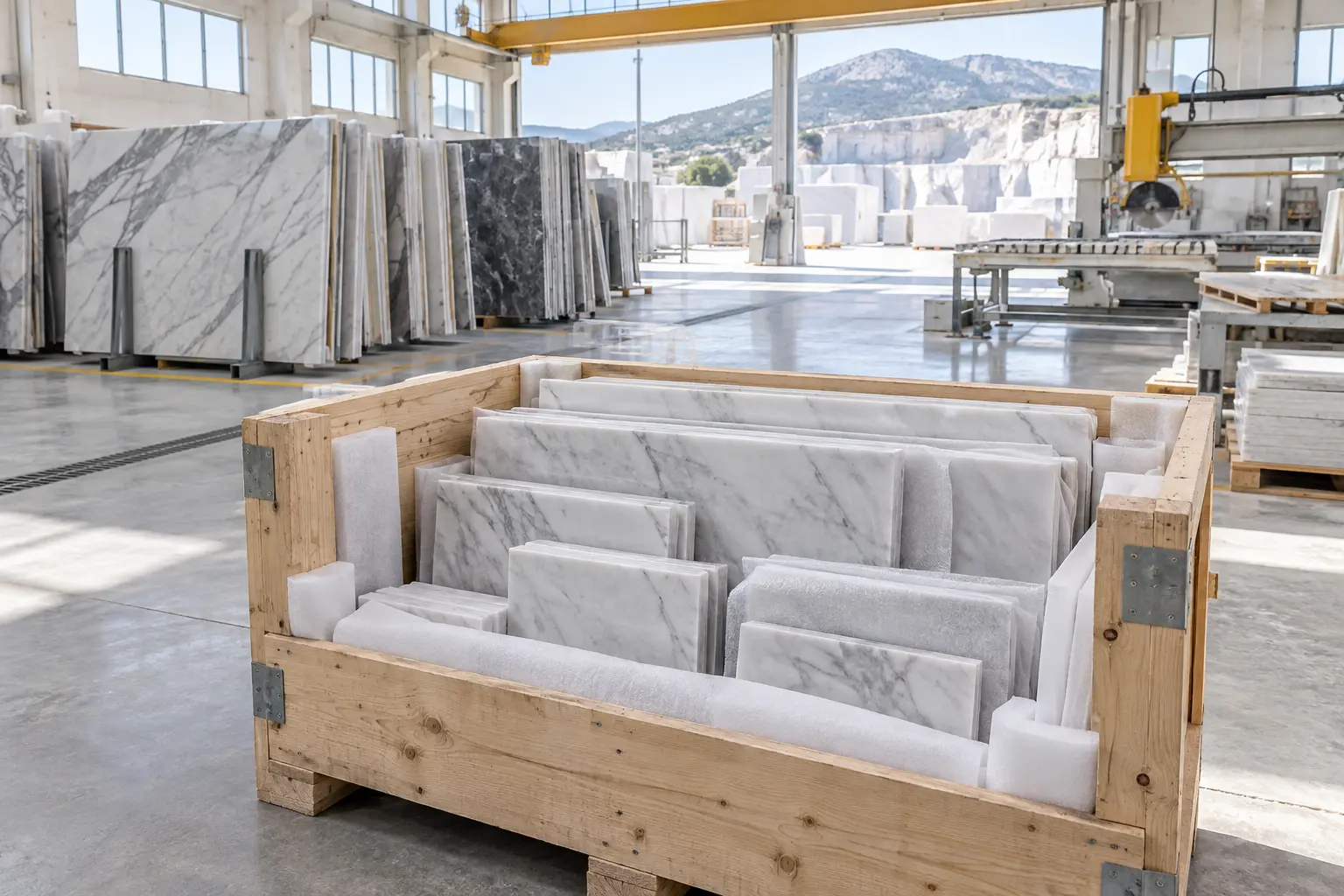
Every package needs robust protective packing and a receiving plan. On arrival, the team should check crate counts and labels against the packing information, note any visible transport concerns and move sensitive pieces into dry, secure storage. Stone is not a material that benefits from being shifted repeatedly around an active site. Keeping it protected from wet works, accidental impact and unplanned handling is a modest discipline with an outsized effect on the finished result.
Keep the decision trail visible
The best stone projects feel uncomplicated when complete because the complicated decisions happened at the right time. Samples establish direction. Slab media and layouts establish character. Production checks establish accuracy. Packing information establishes order. Site preparation establishes a safe handover. Each stage answers a different question, and none needs to be theatrical. Together they create a traceable route from Turkish source material to a British project.
For specifiers, contractors and homeowners in the United Kingdom, this is the real value of working with a specialist producer: not an unrealistic promise of uniformity, but an organised way to use natural variation confidently. When visual intent, production detail and delivery planning are aligned, stone becomes what it should be—an enduring part of the architecture, practical in use and unmistakably its own.